
Take It All In
on my hiking heroes, a living interchange, and the sanctity of suspiring things

Over dinner of Shakshuka and Simit the other night, Steve and Debbie let us thumb through their backpacking photos from the early days. They have always been this way. Tough, often heading out on double-digit-mile hikes with morning still blinking behind the hills. Tender, slowing to delight in the paper-winged moths, busy chipmunks, and little trees pushing out of cracks in porous lava rock. (They are also prepared, tucking hunks of Manchego cheese in their packs for an elevated1 mid-hike culinary experience). After a recent trip to the Cascades, Steve sent this photo he captured of a Columbian Windflower reaching into a pool of light.
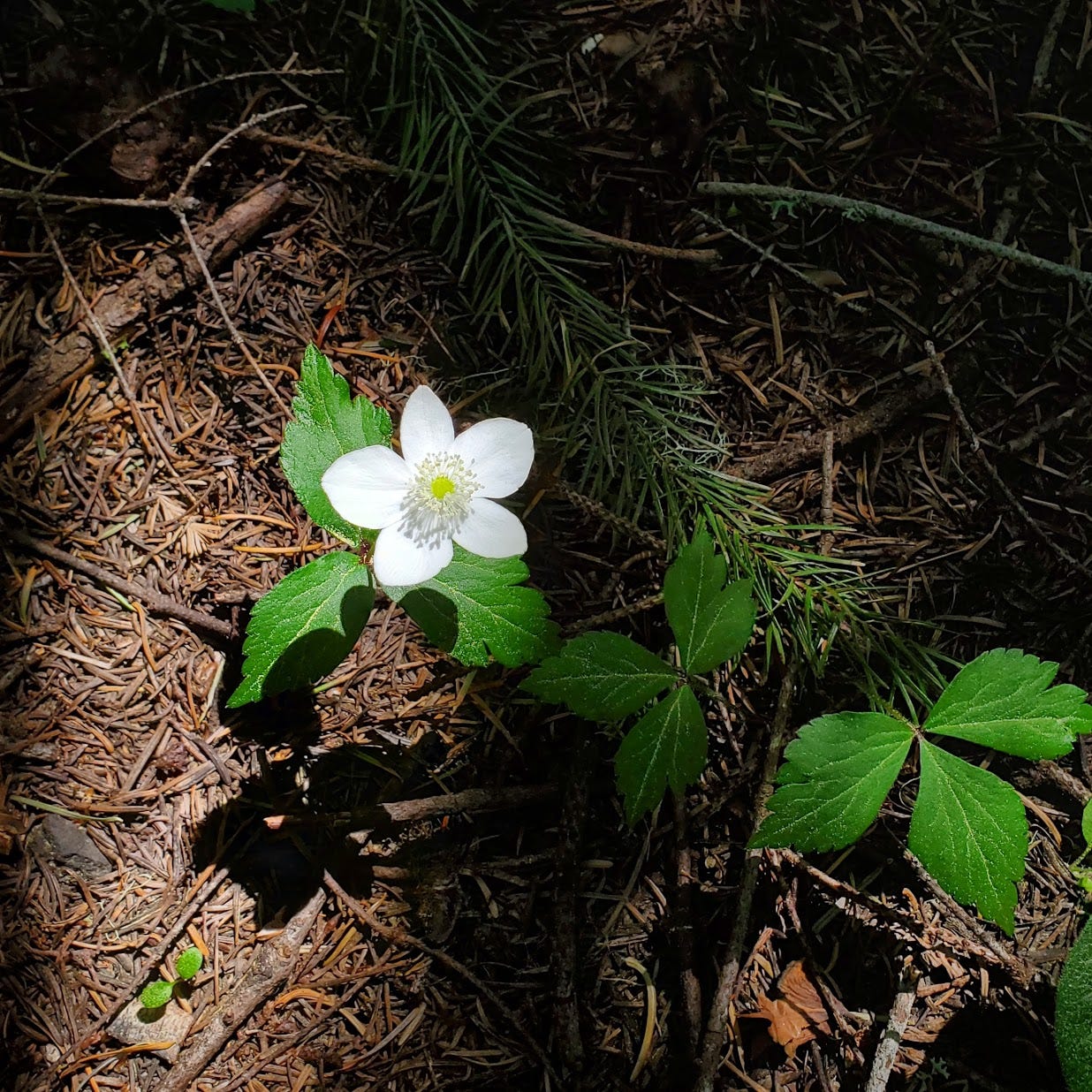
It casts its own shadow near a sprout of new growth. Twigs, pine needles, and last autumn’s leaves fill in a textured backdrop. That I was and continue to be drawn to this photo feels inevitable, innate even. It cannot be unseen. Out in the wilderness east of me, this delicacy, light, decay, and darkness exists. Not everyone will hike with Steve and Debbie, and not everyone will see this photo. There is far more to take in than we can ever hope to. But somewhere in the core of all of us is the answer to an invitation to engage with the subtle and striking ways our surroundings call to us.
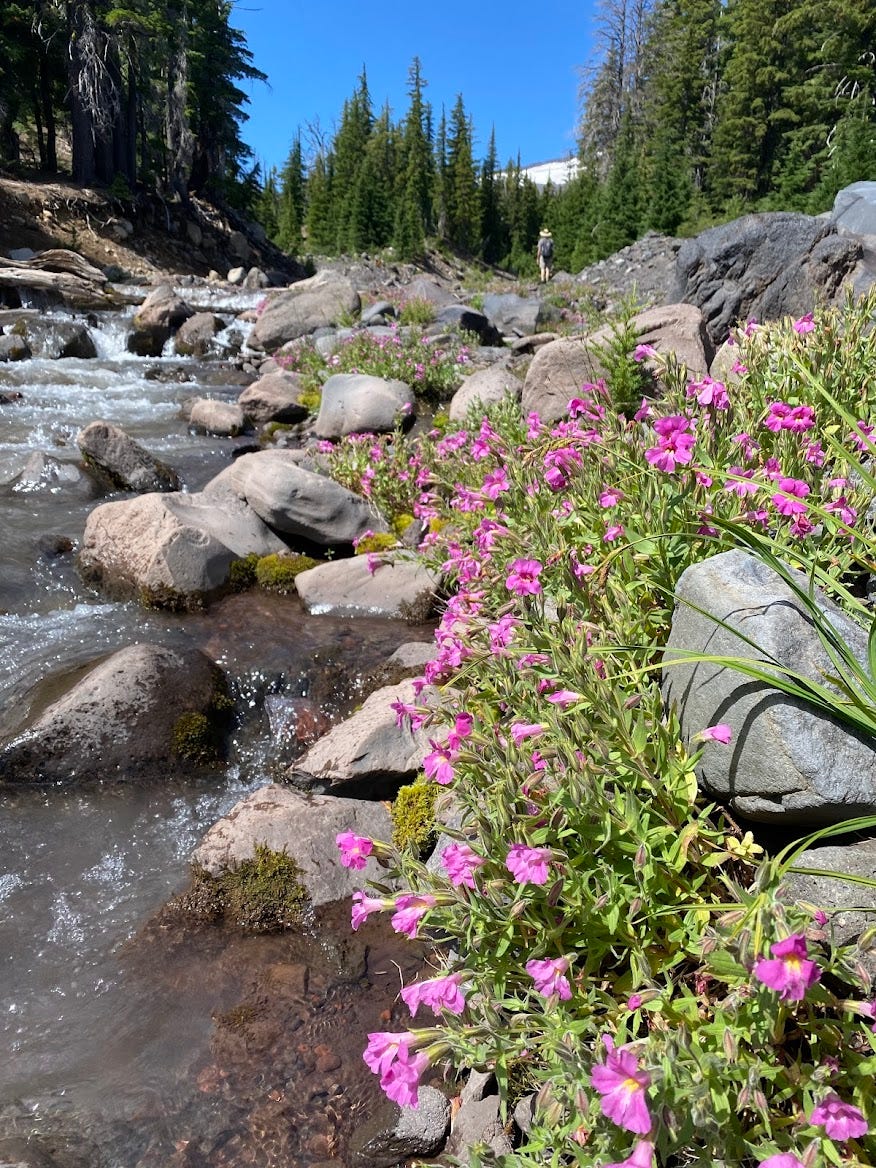
I have written recently about the idea of mutual transformation in human relationships. But what about with the “individual characters of living and growing things, of inanimate beings, of animals and flowers and all nature?”2 What ways could loving symbiosis take place between humans and their places? How might humans relate meaningfully with the creatures chewing and chirping near them?
In his essay “Wild Ethics and Participatory Science: Thinking Between the Body and the Breathing Earth,” David Abram writes,
Each thing that we perceive has its accessible aspects and its hidden aspects, its bright facets that capture our attention and its unseen dimensions that lure us deeper into participation. Hence our perception of any presence is not an instantaneous event but an unfolding dynamic—a living interchange wherein a thing first ‘catches’ our eye, or subtly beckons to our body, to which we reply by focusing our gaze upon it, or reaching out to touch it, whereupon the thing replies by revealing some further facet of itself, and so we are drawn ever deeper into dialogue with the unique allurement of this boulder or that fungus-ridden tree stump.
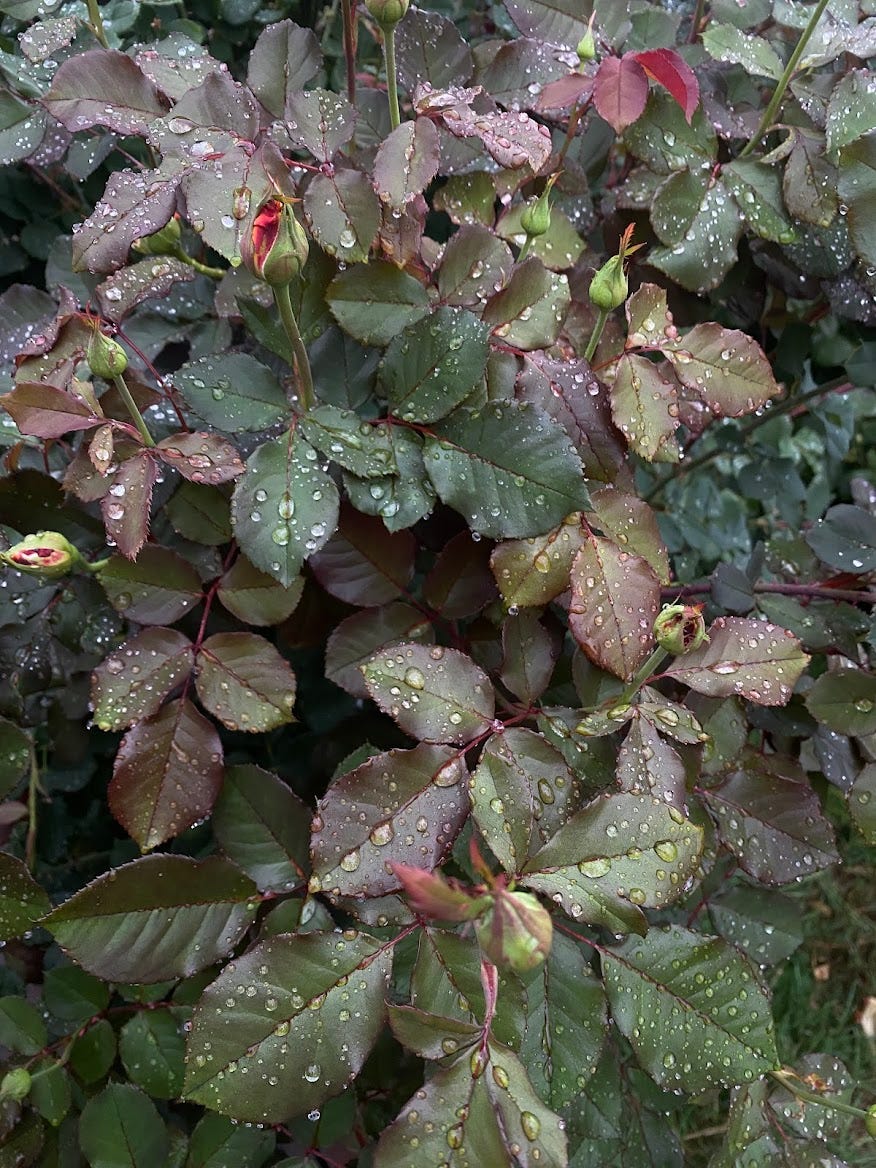
When choosing to participate, we choose to channel our reveling into action. We commit to that living interchange. We let the glass beads holding fast to the rose leaves early after a rain speak to us. Out in the wild, or right out the front door, we uncover some holy, suspiring thing. Debbie and Steve will hike the same trail again and again, only to find new hidden aspects of the dark-eyed junco or South Sister. So too can we allow ourselves this limited knowledge, and be beckoned still.
Thomas Merton, in New Seeds of Contemplation, says it this way:
Therefore each particular being, in its individuality, its concrete nature and entity, with all its own characteristics and its private qualities and its own inviolable identity, gives glory to God by being precisely what He wants it to be here and now, in the circumstances ordained for it by His Love and his infinite Art.
Their inscape is their sanctity. It is the imprint of His wisdom and His reality in them.
The special clumsy beauty of this particular colt on this April day in this field under these clouds is a holiness consecrated to God… The little yellow flowers that nobody notices on the edge of that road are saints looking up into the face of God…
The great, gashed, half-naked mountain is another of God’s saints. There is no other like him. He is alone in his own character; nothing else in the world ever did or ever will imitate God in quite the same way. That is his sanctity.
How will we respond if this is the case? What heft does our attention to small, squirming or large, looming things have in the end? What if when we bend to pick up a feather, we are encountering self, other, and yes, even God?
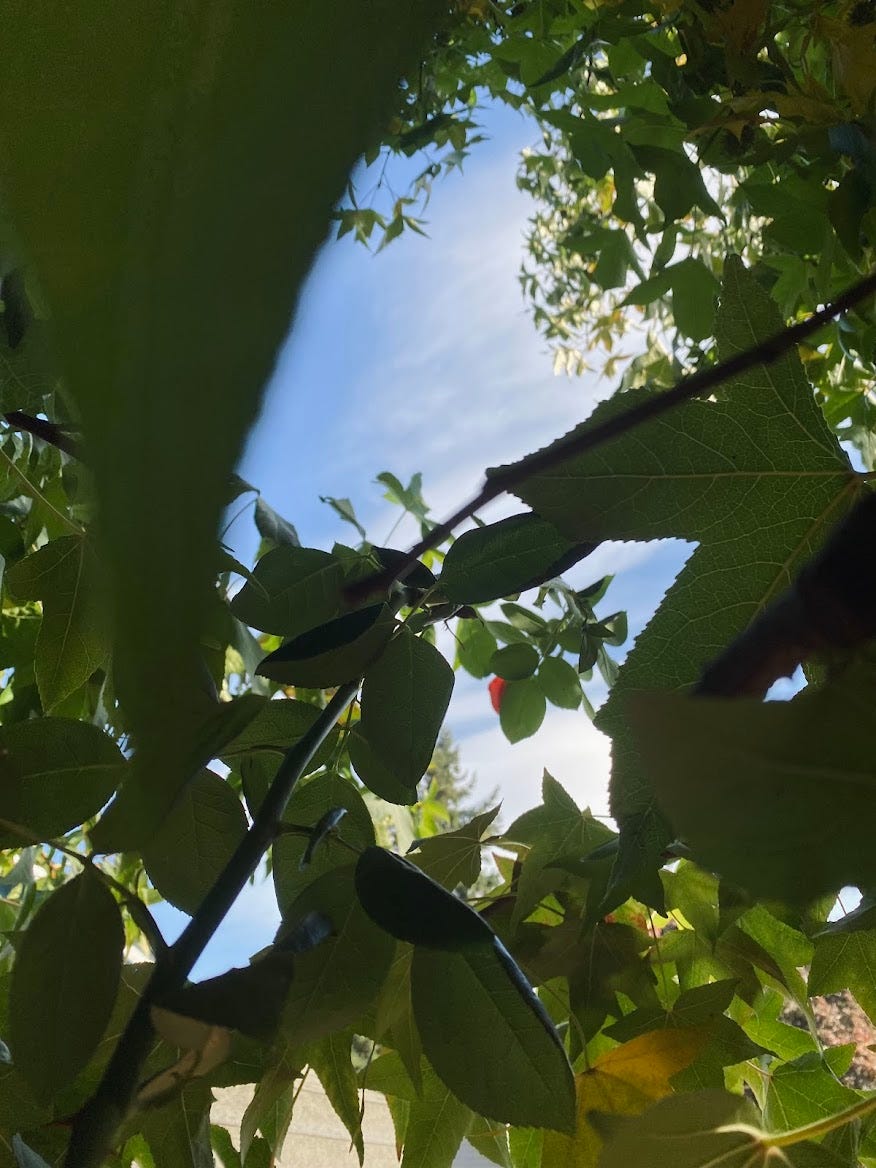
Consider human eyes, hands, noses, ears, and tongues. Really. Blink a few times. Rub the tips of your index fingers on your thumbs. Swallow. Sniff. Take it all in. Our senses bring what is close to the surface even closer. They lure us into participation. They are the handiwork of a God of infinite Art. What might be revealed about us when we are drawn deeper by a natural thing? What is exposed by the ginkgo leaf in your fingertips, the pomegranate seed between your teeth, the scent of rye grass in the gloaming? Glory colliding with glory in unending conversation and change. Take it all in.
Chuffed that you’ve spent time with my writing. I send out an edition of Consonance once-ish monthly. Subscribe to stay up to date. Substack is a wacky, wonderful place where anyone can be a patron of the arts. Bonkers. Are you in?
Big love,
Sarah
This is the part of the show when I share what I’ve been reading, watching, listening to, etc. for the past thirty days. Let’s trade: my unsolicited recommendations for your solicited ones!
Eyes:
Thousand Friends of Rain, Kim Stafford
Marce Catlett: The Force of a Story, Wendell Berry - paired nicely with Russell Moore’s article in CT, “Wendell Berry’s Grief and Gratitude”
Great British Bakeoff - don’t get me started on meringue week
Ears:
As Long As I Am In The Tent Of This Body I Will Make A Joyful Noise Pt. 1, John Van Deusen
“Zeal,” Kinnship
“Chaos of Delight,” John Lucas
All These Years, Phil Cook
Someday I’ll Make It All Up To You, Tyson Motsenbocker
Pardon the mountain pun?
Thomas Merton, New Seeds of Contemplation. New Directions Books, 1972.
Thank you for sharing the photograph taken by Steve Miller! Yes, this photo is rich in spiritual meaning: to the naturalist the cycle of life (a beginning, a middle, and an end) is presented in a beautiful and comforting harmony.
As a Christian, one could see the center of the flower as Jesus Christ, glorified by the five petals that represent the Five Holy Wounds of Christ he received on the cross. The three leaves represent the Trinity. And the abyss shadows that cut out the leaves below the flower point to Isaiah 53:5, "But He was pierced for our transgressions...". We, as humanity, are the fragile cotyledon leaf plant basking below in the radiance of the Lord.